
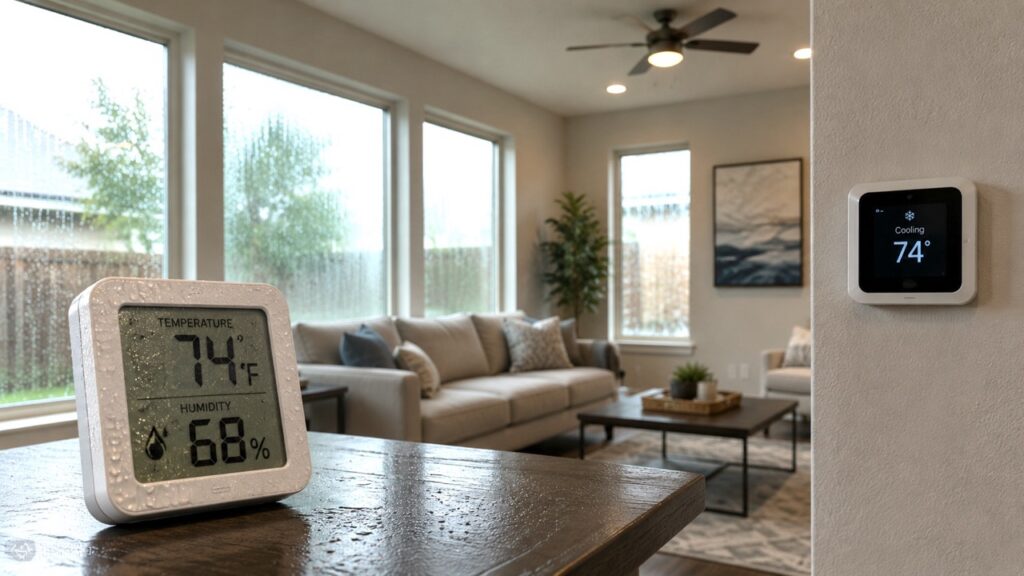
You set the thermostat to a comfortable number, the air conditioner is clearly running, and yet the house still feels sticky, heavy, or clammy. The temperature reads fine, but it doesn’t feel fine. For homeowners in the 77406 area west of Richmond, this is one of the most common—and most misunderstood—comfort complaints we hear.
Here’s the reassuring part: a humid-feeling home usually doesn’t mean your air conditioner is broken. In most cases, the system is doing exactly what it was set up to do—cool the air—but it isn’t removing enough moisture along the way. That’s a different job, and it’s one that gets overlooked surprisingly often in our Gulf Coast climate.
Understanding the difference between cooling and dehumidifying is the key to fixing that uncomfortable, sticky feeling.
Cool but Clammy: A Familiar Fort Bend Complaint
Fort Bend County sits in a warm, humid part of Texas, and outdoor moisture levels stay high for much of the cooling season. That moisture constantly works its way into your home through doors, windows, and everyday activities like cooking, showering, and laundry.
Your air conditioner is supposed to pull a good portion of that moisture back out. When it doesn’t keep up, you get a home that’s technically “cool” by the thermostat but still feels muggy. Many homeowners respond by lowering the temperature even further—only to end up with a house that’s cold and clammy, which is even less comfortable.
The real fix starts with understanding why the moisture is staying behind in the first place.
Why Humidity Is a Separate Problem From Temperature
An air conditioner actually does two jobs at once:
- It lowers the air temperature (the part you feel as “cooling”)
- It removes moisture from the air as that air passes over the cold indoor coil
The second job happens because warm, humid air hitting a cold coil causes water to condense out—the same way a glass of iced tea sweats on a hot day. That water drains away, and the air that returns to your rooms is both cooler and drier.
The catch is that moisture removal takes time. The system has to run long enough, in steady cycles, for meaningful amounts of water to condense off the coil. When a system cools the air quickly but doesn’t run long enough to dry it, you get a home that hits its temperature target while still feeling humid.
This is why two homes set to the exact same temperature can feel completely different.
How an Oversized System Makes Humidity Worse
It may sound backward, but one of the most common reasons a 77406 home feels humid is that the air conditioner is too large for the space—not too small.
Here’s what happens. An oversized system cools the air very fast. It blasts the temperature down to the thermostat setting in a short burst, then shuts off. Because it satisfied the temperature so quickly, it never ran long enough to pull much moisture out of the air. Then a few minutes later it kicks back on, cools fast again, and shuts off again.
These short, frequent cycles are called short-cycling, and they’re tough on comfort because:
- The system rarely runs long enough to dehumidify
- Moisture keeps building up between cycles
- The home stays cool but muggy no matter what number is on the thermostat
This is an important distinction from a system that’s undersized and can’t reach the set temperature at all. An oversized system reaches temperature easily—it just leaves the humidity behind.
The Role of Runtime in Moisture Removal
Because dehumidification depends on runtime, anything that cuts a cycle short or limits how the system runs can leave moisture in the home. Beyond oversizing, a few setup choices commonly contribute in 77406 homes:
- Fan set to “on” instead of “auto.” When the blower runs continuously, it can blow moisture that condensed on the coil right back into the house before it has a chance to drain away. Switching the fan to “auto” often improves how dry the home feels.
- Single-stage equipment that only runs at full power, so it cools in short bursts rather than long, steady cycles.
- Thermostat settings that prioritize hitting a temperature fast over running gentle, longer cycles.
None of these mean the equipment is failing. They’re about how the system runs, which is usually adjustable.
Signs Your Comfort Issue Is Humidity, Not Cooling
It helps to know whether you’re dealing with a moisture problem or an actual cooling shortfall. Humidity is often the culprit when you notice:
- The thermostat reads the right temperature, but the air still feels heavy or sticky
- The home smells musty or damp, especially in closets or lower-traffic rooms
- Windows, vents, or surfaces show condensation or feel clammy
- You keep lowering the thermostat without ever feeling truly comfortable
- The house feels worse on rainy or especially humid days, even when it isn’t hotter outside
If the home actually struggles to reach the set temperature at all, that points toward a different issue—capacity or airflow—rather than humidity alone.
Solutions Beyond “Just Turning It Colder”
The instinct to crank the thermostat down is understandable, but with a humidity problem it usually backfires—you end up colder, the system short-cycles more, and the air stays just as damp.
Better approaches focus on giving the system the runtime it needs to remove moisture:
- Right-sizing the system. If equipment was oversized during construction, correcting that mismatch lets it run in longer, steadier cycles that actually dry the air.
- Variable-speed or two-stage equipment. These systems can run longer at lower output, which is far better for moisture removal than full-blast bursts.
- Switching the fan to “auto” so condensed moisture drains instead of re-circulating.
- Adding dedicated dehumidification in homes where the cooling load and moisture load don’t line up well—common in tighter, well-built newer homes.
- Sealing and airflow improvements that reduce how much outdoor humidity sneaks in and keep the system working efficiently.
The right combination depends on your specific home, which is why a look at how your system actually runs matters more than any single quick fix.
Getting to the Bottom of a Humid Home in 77406
A muggy home isn’t something you have to accept as “just how it is” in our climate. The goal is to figure out why moisture is staying behind and then match the solution to the cause—whether that’s how the system is sized, how it cycles, or how air moves through the home.
A thorough evaluation generally looks at:
- How long the system runs per cycle and whether it’s short-cycling
- Whether the equipment is sized appropriately for the home
- Fan and thermostat settings affecting moisture removal
- Indoor humidity levels compared to where they should be
- Whether added dehumidification would resolve the issue more directly
From there, the right recommendation is the practical one—not the most expensive one.
Honest Help for Humidity Problems in 77406
At Critical Air, we help homeowners across Richmond and the 77406 area get to the real reason their homes feel humid—instead of just chasing the thermostat. Our focus is on diagnosing whether the issue is sizing, runtime, airflow, or moisture load, and recommending the solution that actually makes your home comfortable.
If your house feels sticky even when the AC is running, we’re here to help you understand why and what can be done about it.
Call Critical Air Today at 281-468-4250
Schedule Your Free AC Repair Sugar Land Evaluation at criticalairhvac.com/contact-hvac-sugar-land-tx