
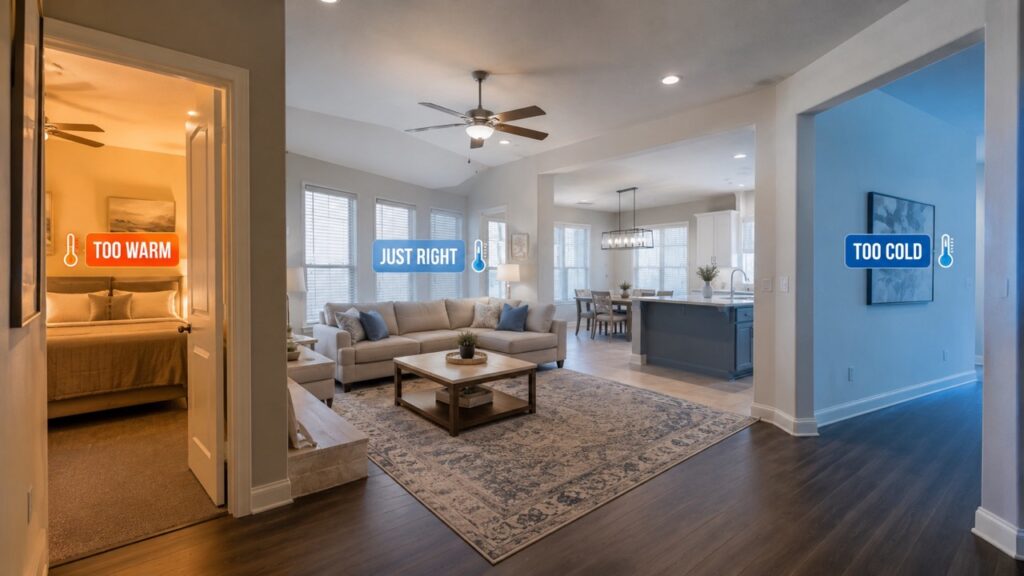
In a lot of newer 77407 homes, there’s one room that just never seems to get it right. Maybe it’s the bonus room over the garage that runs warm all afternoon, the upstairs that won’t cool while the downstairs is freezing, or a back bedroom that always feels a few degrees off from the rest of the house.
If that sounds familiar, here’s the reassuring part: this usually isn’t a sign that your air conditioner is failing. In newer homes across the fast-growing 77407 area, uneven temperatures are far more often a matter of how air is distributed through the house than a problem with the equipment itself. And because it’s a distribution issue, it’s frequently something that can be improved with the right adjustments—not a major replacement.
Understanding why certain rooms feel “off” is the first step to getting your whole home comfortable.
The “One Room Is Always Wrong” Problem
Almost every home has a problem room. In newer 77407 neighborhoods, the usual suspects are:
- Rooms over the garage, which sit above an unconditioned space and pick up extra heat
- Upstairs bedrooms, where heat naturally collects
- West- and south-facing rooms that bake in afternoon sun through large windows
- Rooms farthest from the air handler, where airflow has the longest path to travel
When one or two rooms consistently run warmer or cooler than the rest, it’s rarely because the air conditioner can’t make cold air. It’s because that cold air isn’t reaching every room in the right amount. That’s an airflow balance problem.
How Modern Layouts Challenge Airflow Balance
It might seem like a newer home should have an easier time staying comfortable than an older one. But the way many homes are built today actually makes even airflow harder, not simpler.
Newer 77407 homes often feature:
- Open floor plans where large connected spaces share air unevenly
- Two-story designs that have to fight the natural tendency of hot air to rise
- High and vaulted ceilings that create large volumes of air to condition
- Lots of glass that adds heat to specific rooms at specific times of day
A single air conditioning system and a single thermostat are often asked to keep all of this balanced at once. When the thermostat is satisfied by the temperature in its location, it shuts the system off—even if a room down the hall or upstairs hasn’t caught up yet.
This is worth separating clearly from the kind of duct problems seen in much older homes. In an aging house, the ducts themselves may be deteriorating, leaking, or undersized from decades of wear. In a newer 77407 home, the ductwork is typically intact and in good condition—it just may not be balanced for how the home actually heats up and cools down. The materials are fine; the distribution needs tuning.
Registers, Dampers, and Return Air—Explained Simply
A few basic parts control how air moves through your home. Understanding them makes uneven cooling far less mysterious.
- Supply registers are the vents that push cooled air into each room. Their size, number, and placement affect how much air a room gets.
- Dampers are adjustable plates inside the ductwork that control how much air flows down each branch. Balancing them sends more air where it’s needed and less where it isn’t.
- Return air is how the system pulls air back to be cooled again. If a room can push air out but has no easy path back to a return, airflow stalls and comfort suffers.
When these elements aren’t tuned for your specific home, some rooms get more than their share of conditioned air while others are starved. The fix is often a matter of adjusting the balance rather than replacing anything.
Why Two-Story 77407 Homes Are Especially Prone to This
Two-story homes face a basic challenge of physics: warm air rises and settles upstairs, while cooler air sinks to the ground floor. This is sometimes called the stack effect, and it’s a leading reason the upstairs of a 77407 home feels warm while the downstairs feels cold.
A single system trying to serve both floors will almost always favor one over the other, because:
- The thermostat usually sits on one floor and reads only that floor’s temperature
- Cooled air delivered to the second floor has to overcome the heat constantly rising into it
- Afternoon sun loads the upstairs rooms more heavily than the shaded ground floor
This is a comfort and distribution challenge, not a sign of a worn-out system. Solutions range from airflow balancing to, in some homes, adding zoning so each floor can be controlled independently.
What Balancing Actually Involves
“Balancing” can sound vague, so here’s what it really means in practice. The goal is to measure how air is actually moving through the home and then adjust the system so each room gets the right amount.
A proper balancing process generally includes:
- Measuring airflow at registers throughout the home, rather than guessing
- Adjusting dampers to redirect air toward rooms that run warm
- Tuning registers and checking that returns aren’t restricted
- Evaluating thermostat placement to make sure it represents the home well
- Considering zoning for homes—especially two-story ones—where one system genuinely can’t satisfy every area at once
The aim is steady, even comfort across the whole house, achieved by optimizing what’s already installed before anyone suggests bigger changes.
When It’s Airflow vs When It’s the Equipment
Most uneven-cooling complaints in newer homes come down to distribution. But it’s worth knowing the difference, because the right fix depends on the cause.
Usually an airflow or balance issue when:
- One or two specific rooms are consistently off while the rest of the home is fine
- The problem follows the sun or the time of day
- Upstairs and downstairs differ predictably
Possibly an equipment or sizing matter when:
- The entire home struggles to reach the set temperature
- The system runs constantly without ever catching up anywhere
- Comfort problems are widespread rather than room-specific
Telling these apart is exactly what a good evaluation is for—so the solution targets the real cause instead of treating symptoms.
Getting Every Room Comfortable in Your 77407 Home
You shouldn’t have to close vents, run space heaters, or avoid certain rooms to stay comfortable in a newer home. In most cases, the equipment is perfectly capable—it just needs the air balanced so every room gets its fair share.
A thorough evaluation of a newer 77407 home looks at airflow at each register, damper and return-air setup, thermostat placement, and how the layout drives heat gain room by room. From there, the right next steps are usually practical adjustments rather than expensive overhauls.
Even, Reliable Comfort for 77407 Homes
At Critical Air, we work with homeowners throughout the 77407 area and the wider Fort Bend County region whose newer homes have rooms that never quite feel right. Our focus is on finding what’s throwing off the balance and recommending the most practical way to fix it—not selling equipment you don’t need.
If certain rooms in your home are always too hot or too cold, we’re here to help you understand why and even things out.
Call Critical Air Today at 281-468-4250
Schedule Your Free AC Repair Sugar Land Evaluation at criticalairhvac.com/contact-hvac-sugar-land-tx